Predictions
How several people state their own view on the same node, and how those views become one number the map can use.
Some nodes hold a belief people can reasonably disagree about. Those nodes accept predictions — one person's stated view, kept separately from everyone else's.
Which nodes accept them
Three kinds, and only three:
- Binary Probability
- Distribution
- Metaculus Question, in a type that can feed a forecast
A Parameter is a constant, a Base Rate is retrieved data, and a Formula is derived from other nodes. None of them holds an opinion, so none offers prediction controls.
A Metaculus question in a type that cannot feed a forecast — date, multiple-choice, group, or conditional — is not a forecast input at all, so it is offered no prediction controls either. A prediction filed against it would go nowhere.
Several people, several predictions
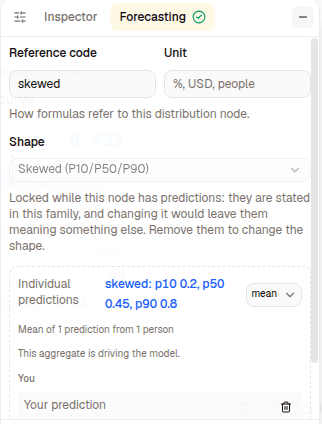
More than one person can predict on the same node, and one person can add more than one prediction. Each contribution remains visible rather than overwriting someone else's.
Your own predictions appear at the top of the list. Everyone else's follow in a stable order.
How they become one number
The map needs a single value per node, so predictions are folded together. The node chooses how:
- Mean — the default
- Median — less sensitive to one outlying view
Everything downstream sees the folded result. A formula reading the node does not know how many people contributed to it.
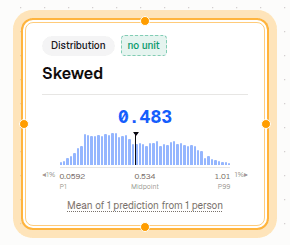
The card states the resolved value and how it was reached, so you can see at a glance whether you are looking at one person's view or six.
Predicting
Predictions are stated with the same controls the node's own authored value uses — a probability for a Binary Probability node, a family and its parameters for a Distribution.
Once a node has predictions, its authored value is hidden.
When predictions disagree in shape
Two problems can arise, and they are treated differently.
A prediction in the wrong shape — a distribution filed on a probability node, say — is ignored, and the node reports how many it skipped:
Ignored 2 prediction(s) that do not match this node's shape.
That is a warning. The remaining predictions still fold normally.
Predictions using different distribution families cannot be combined at all:
Predictions on this node use different distribution families, so they cannot be combined.
That is an error, and the node produces no value until the contributors agree on a family. It is also why changing a node's family deletes the predictions stated in another one, after asking.
Who can predict
Predicting requires write access to the project. A reader can see the predictions and the resolved value, but cannot add their own.
Metaculus questions
A Metaculus node carries the community forecast by default. A prediction on it replaces that value for your map — the community number stays visible as the source, and the node shows your figure as the one in use.
An untouched community forecast is not repeated as a separate result; the card shows one number until somebody overrides it.